Flat Roof Options for Garages and Extensions: Felt, EPDM or GRP?
Compare felt, EPDM rubber and GRP fibreglass, including the preparation, detailing and drainage every flat roof needs.
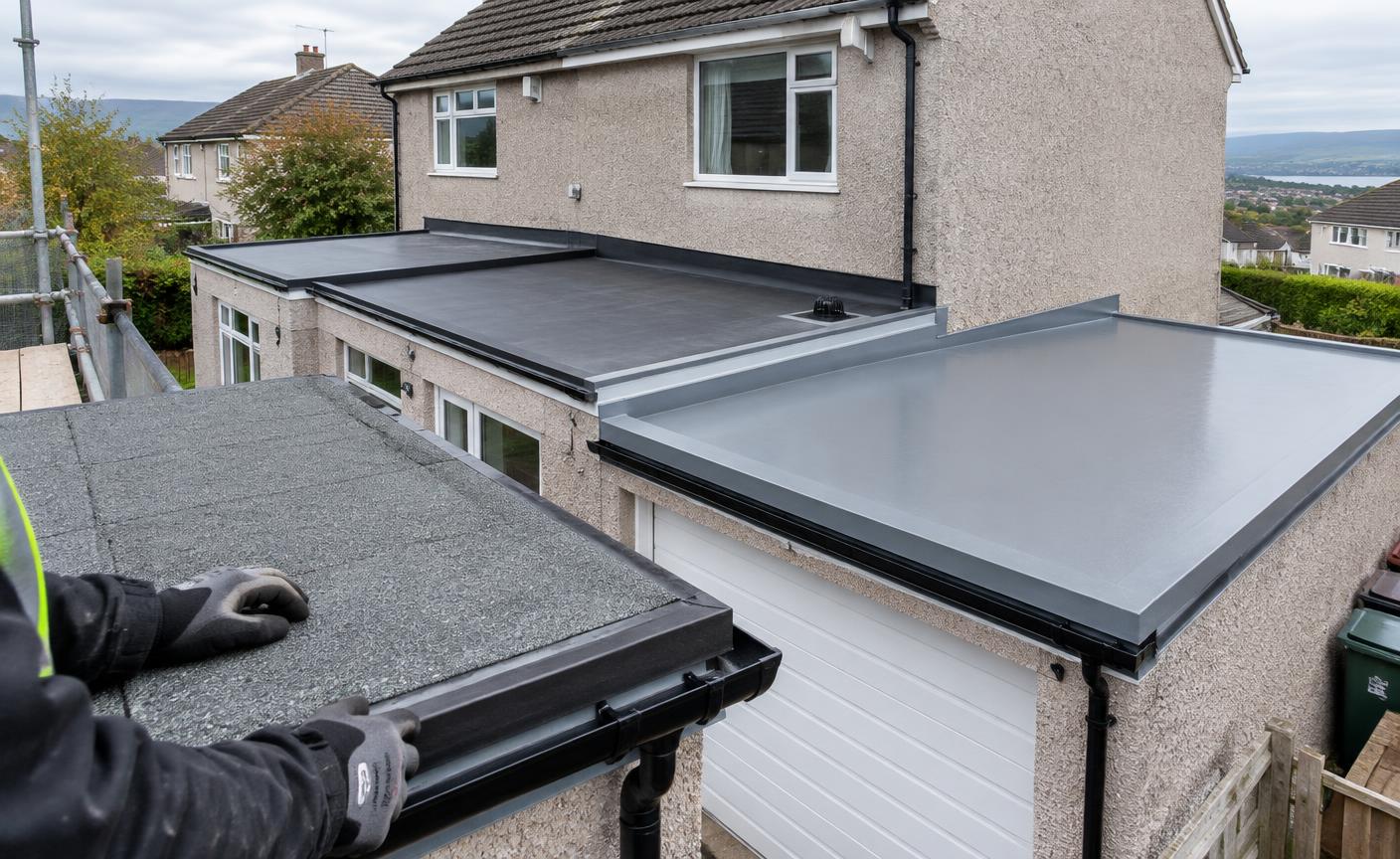
Garages, extensions, dormers and porches across Central Scotland often use a flat or low-pitched roof. Despite the familiar name, the surface should never be completely level. It needs a deliberate fall that guides rain towards a gutter or outlet, along with secure edges and carefully formed junctions where the roof meets a wall, rooflight or pipe.
Felt, EPDM rubber and GRP fibreglass can all provide effective weatherproofing when specified and installed correctly. There is no single material that is automatically best for every building. Roof shape, deck condition, access, movement, outlets and the number of penetrations all influence the choice. The quality of preparation usually matters as much as the visible finish.
Start with the roof deck and drainage
Every flat roof system depends on a stable, suitable deck. If boards are damp, weakened or uneven, covering them hides rather than solves the problem. During replacement, the old surface is removed so the deck and supporting structure can be inspected. Damaged sections are renewed and the base is prepared to meet the chosen system’s requirements.
The fall must carry water towards a clear outlet without relying on the membrane to tolerate avoidable ponding. Upstands at walls need sufficient height and the roof edge must discharge cleanly into the gutter. A survey should consider the complete rainwater route, including fascia, gutter joints, outlets and downpipes.
High-performance roofing felt
Modern roofing felt is very different from the simple coverings sometimes associated with old sheds. A properly specified system uses compatible layers that are bonded and detailed to form a continuous waterproof surface. Mineral-finished cap sheets are familiar on domestic garages and extensions, and felt can be dressed neatly around many common roof shapes and upstands.
Installation requires a clean, correctly prepared substrate and close control at laps, corners and edges. The chosen application method must suit the building and surrounding materials. Felt can be practical for roofs with several details, but workmanship is crucial: poorly sealed laps or weak perimeter work can allow water beneath an otherwise sound field area.
EPDM rubber roofing
EPDM is a flexible synthetic rubber membrane. On a simple roof it can often be installed in a large sheet, reducing the number of field joints. The membrane is bonded to a suitable deck, with dedicated trims, adhesives and accessories used around edges, outlets and penetrations. Its flexibility can accommodate normal movement when the complete system is designed correctly.
Accurate preparation remains essential. Dust, damp or an unsuitable substrate can affect adhesion, while corners and wall junctions need more than a casual application of sealant. The appearance is usually smooth and understated. EPDM is often considered for garages and extensions with relatively straightforward shapes, although each roof still needs an individual assessment.
GRP fibreglass roofing
GRP uses glass-fibre reinforcement and resin to create a rigid, seamless surface across the prepared deck. It can produce crisp edges and a clean finish, which suits many extensions, dormers and porches. Trims form the perimeter and drainage details, while the reinforced field is built up and finished as one system.
Because GRP cures as a rigid covering, deck preparation, joint treatment and weather conditions during installation are particularly important. Movement must be considered on larger or more complex roofs. Corners, outlets and wall abutments require careful workmanship, and the installer should follow a coherent specification rather than mixing unrelated materials.
How the three systems compare
Felt is versatile and familiar, EPDM offers a flexible membrane that can minimise field seams, and GRP creates a hard, seamless finish. Those broad differences are useful, but they do not decide the answer alone. A roof with many awkward details may favour one approach, while a simple open deck may suit another. Existing construction and how the roof connects to the main building also matter.
Ask how corners, wall upstands, door thresholds, rooflights and outlets will be formed. The most important comparison is between complete specifications, not just material names. A strong proposal explains deck preparation, falls, trims, drainage and the treatment of any damp or decayed substrate found after stripping.
Common signs a flat roof needs attention
Indoor damp, lifting seams, bubbles, cracks and loose perimeter trims all deserve investigation. Standing water that remains long after rainfall can point to inadequate falls or a blocked outlet. Staining on fascia boards or walls may show that water is overshooting the gutter or tracking behind an edge detail. A visible defect should be assessed before moisture spreads into the deck.
Not every mark requires a complete replacement. A local repair may be proportionate where the surrounding system and deck remain sound. Widespread splits, repeated leaks, failed edges or a weakened substrate can make renewal more dependable. Photographs help explain the distinction and provide a record of hard-to-see areas.
Do not forget roofline and gutters
A flat roof cannot perform properly if the outlet below it is blocked or the gutter runs the wrong way. Overflow can soak walls, stain render and damage fascia boards even when the main membrane is intact. Leaves, moss and roof debris should be cleared, and downpipes checked for obstruction or separated joints.
When renewing a garage or extension roof, it is sensible to inspect adjoining fascias, soffits and gutter brackets while access is available. The edge trim and rainwater system must work together. Correcting the surface without addressing a failed outlet simply moves the problem to the roof perimeter.
Choose after a proper survey
The right system follows from the building, not a universal ranking. We inspect the covering, deck, falls, junctions and drainage before discussing felt, EPDM or GRP. The written quote then explains preparation and detailing, allowing the homeowner to understand how the finished roof will move water away and protect the structure below.
Roofing Central Scotland works on flat roofs in Livingston, where garages and extensions are common, and across Falkirk and nearby towns. Our flat roofing service includes repairs and complete replacements, while our roofline and guttering work can address the drainage route at the same time. Every survey includes photographs and clear, no-pressure advice.